
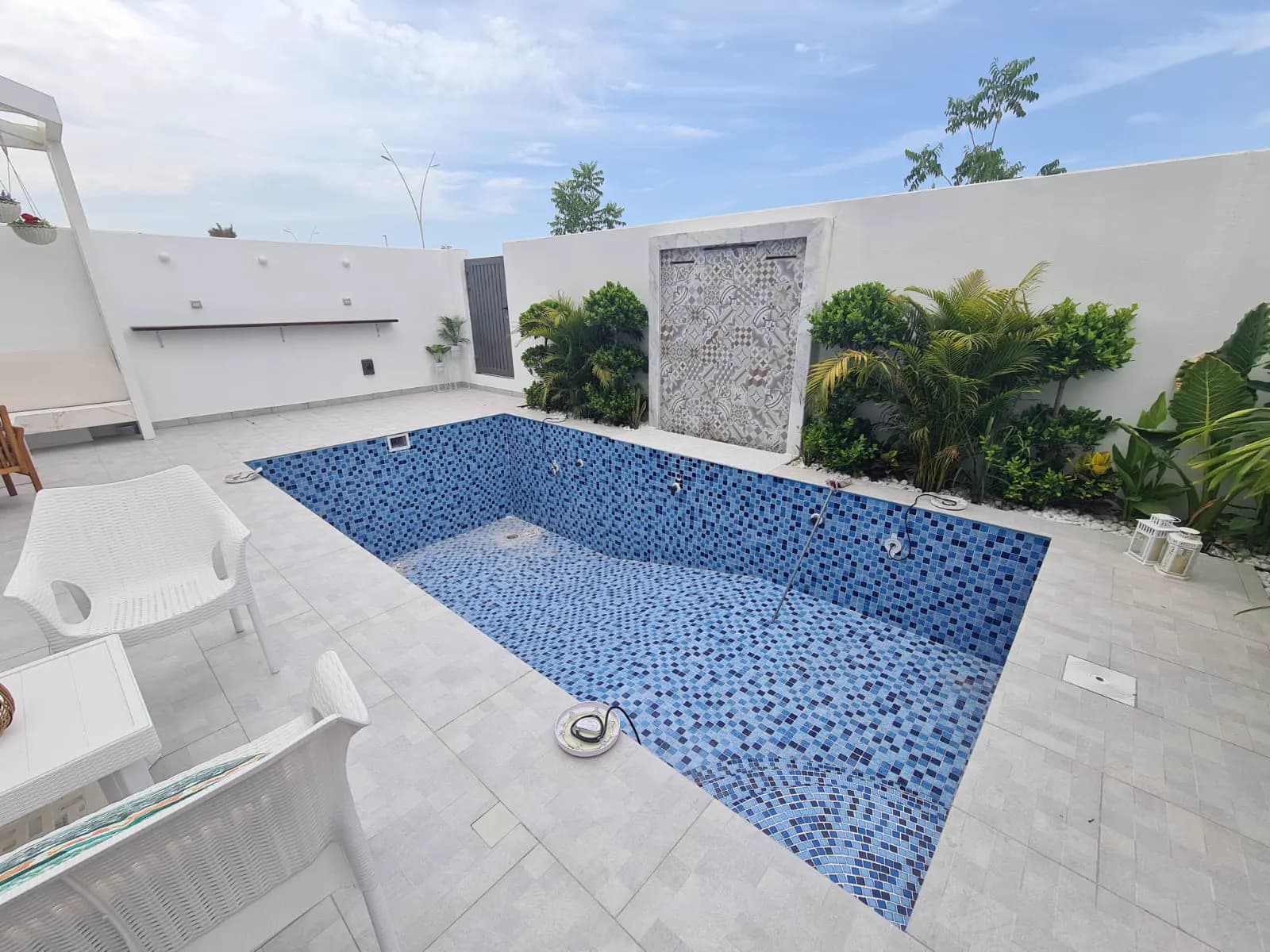
A swimming pool looks like a landscape item and behaves like a mechanical installation. The visible part is a tiled box of water; the part that determines whether you enjoy it is a filtration circuit, a set of drainage provisions and a waterproofing detail, all of which become very expensive to change once the surrounding garden is finished.
Approvals come first
In Abu Dhabi a private pool requires approval before excavation begins. The Department of Municipalities and Transport operates a streamlined permit route for minor works on residential properties — villas, farmhouses and holiday homes — and swimming pool construction is explicitly within it, which means a licensed contractor can secure the approval directly rather than routing it through a longer building-permit process.
If the villa sits inside a managed community, that is not the only approval. The developer or community management will have its own submission, its own set-back and boundary rules, and often its own restrictions on working hours and material deliveries. Safety provisions — barriers and gates, depth marking, and the pool's own drainage — form part of the approval rather than being an afterthought at handover.
Where the plant room goes
This is the decision most often deferred and most expensive to reverse. The filtration equipment, circulation pumps, balance tank, chemical dosing and their electrical supply need a location that satisfies four separate constraints at once: it must be below the pool's water line for the hydraulics to work sensibly, accessible for maintenance without lifting paving, drained so that a leaking union does not flood it, and positioned so the pump noise is not carried into a bedroom or a majlis.
Solve that on a drawing and it costs nothing. Solve it after the shell is poured and the landscape is set out, and you are choosing between a longer pipe run that costs you flow rate for the life of the pool, or lifting finished work.
Decisions to fix before excavation
- Overflow or skimmer. A deck-level overflow pool needs a balance tank, a wider channel detail and a higher standard of level accuracy in the shell; a skimmer pool does not. This is a structural decision, not a finish.
- Waterproofing system. The membrane or cementitious system and, critically, how it is detailed at inlets, lights, steps and the coping — because failures are almost always at penetrations rather than in the field.
- Tile or plaster finish. Mosaic, large-format tile and rendered finishes differ in substrate tolerance and in how they behave with movement, so the shell has to be built for the finish that was chosen.
- Lighting circuits and their conduits, which have to be cast into the shell.
- Heating or chilling. Abu Dhabi pools are often cooled rather than heated in summer; either way the plant, its power and its position are part of the same room.
- The landscape interface — coping level, deck drainage falls away from the pool, and irrigation lines that must not cross the pool's own services.
What the Gulf climate does to a pool
Two things, continuously. Evaporation is high, which means make-up water, which means water chemistry drifts faster than in a temperate climate and salt or mineral content concentrates. And airborne dust loads the filtration far more heavily than the equipment's rated duty cycle assumes. Both are manageable, and both are the reason pools here are best kept under a maintenance contract rather than checked when something looks wrong: by the time the water looks wrong, the correction is chemical rather than routine.
Why the pool and the garden should be one contract
The pool shell, the deck, the drainage, the irrigation, the outdoor lighting and the electrical supply to the plant room all occupy the same few metres of ground, and each of them has a level that has to be right relative to the others. Split them across a pool contractor and a landscaper and the interface becomes a negotiation on site, usually resolved by whoever gets there first. Eagle builds pools and landscape as one scope for exactly that reason — including, on the resort work we maintain, keeping them running afterwards.
Related questions.
Do I need a permit to build a swimming pool at my villa in Abu Dhabi?
Yes. A private pool in Abu Dhabi needs approval before excavation, and if the villa sits inside a managed community the developer's approval is required as well as the municipal one. DMT has a streamlined permit route for minor works on residential properties which covers swimming pool construction, and a licensed contractor can secure it directly. Safety requirements — barriers, depth marking, and the pool's own drainage and filtration provisions — are part of the approval, not an optional extra afterwards.
What should be planned before a pool is excavated?
The plant room. The filtration equipment, pumps, balance tank and their power and drainage need a location, an access route for maintenance, and a noise position that does not sit under a bedroom window — and all of that is far cheaper to decide before the shell is poured than after the landscape is finished. Waterproofing detail, tile finish, lighting circuits and the interface with the surrounding hardscape should be resolved at the same time, because each of them crosses into another trade.
Want this applied to your project?
More insights.
What survives a UAE summer: specifying outdoor materials that last
Why outdoor specifications fail in the Gulf — UV, surface temperature, salt and dust — and the material choices that hold up in Abu Dhabi landscape and hardscape.
7 min
What an office fit-out in Abu Dhabi actually involves
The approvals, the programme and the decisions that set the cost of a commercial fit-out in Abu Dhabi — written by the contractor who has to build it.
8 min